
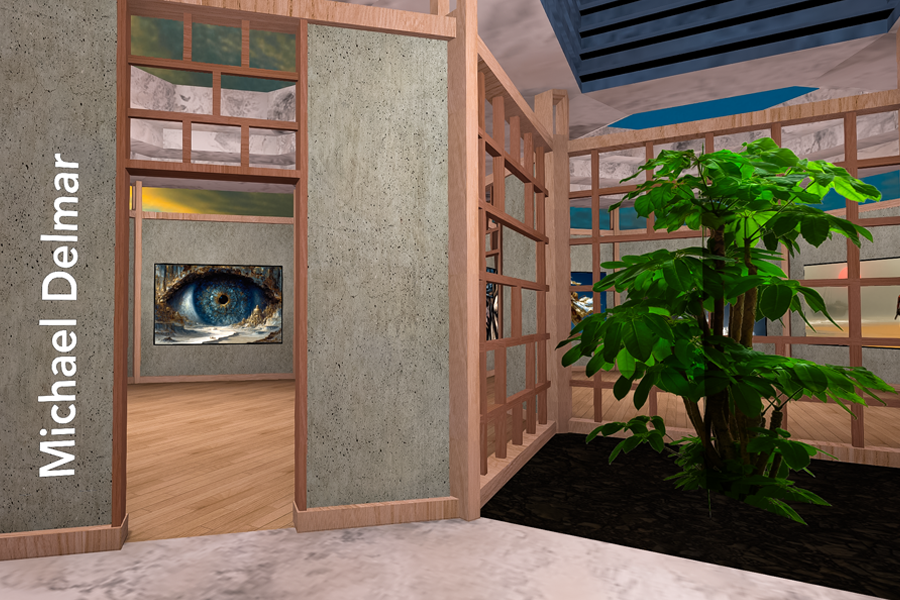
There is a sense, when moving through Michael Delmar’s work, that one is not simply looking at images but passing through a sequence of thresholds. His figures—nomads, dancers, marionettes, mythic travelers, winter spirits—do not merely inhabit their worlds; they endure them, resist them, and move through them with quiet resolve. Across multiple galleries and bodies of work, Delmar constructs a visual language that blends fantasy, history, futurism, and ritual into something both intimate and archetypal.
Delmar describes his process as beginning not with technique but with meaning. “I start with an idea of a scene or a story,” he explains, “and I play with the words to do that.” This narrative impulse is central to his practice. Each image feels like a moment extracted from a longer tale—one already in motion before we arrive and continuing after we leave. His interest lies, as he puts it, in “Value and Meaning,” and in deciding how that meaning should be carried: through a particular historical style, a cultural reference, or the quiet dignity of a single figure.
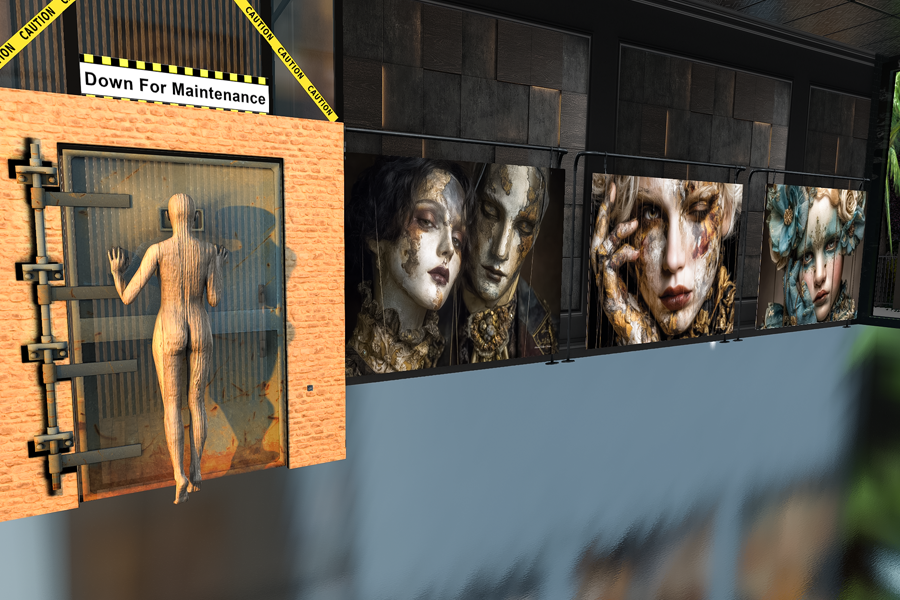
That presence is unmistakable. Whether portraying a regal woman meeting the viewer’s gaze head-on, an older nomad riding a cybernetic beast across a wind-scoured plain, or a dancer bound by puppet strings, Delmar treats his subjects as fully realized individuals rather than decorative forms. “I am also doing my best to give my characters dignity as a person,” he notes—an ethic that runs consistently through his work, regardless of genre or setting.
A striking feature of Delmar’s imagery is the way it negotiates the relationship between subject and viewer. Many figures look directly outward, establishing an immediate, almost confrontational intimacy. Others turn away, or appear visibly controlled—literally tethered by strings. Rather than dictating how we should respond, Delmar leaves that connection open. “I think people connect with the art by their own life’s experiences,” he says. “What resonates with that viewer.” For him, the measure of success is not consensus but resonance—whether the image strikes something true in the viewer because it has already struck something true in the artist.
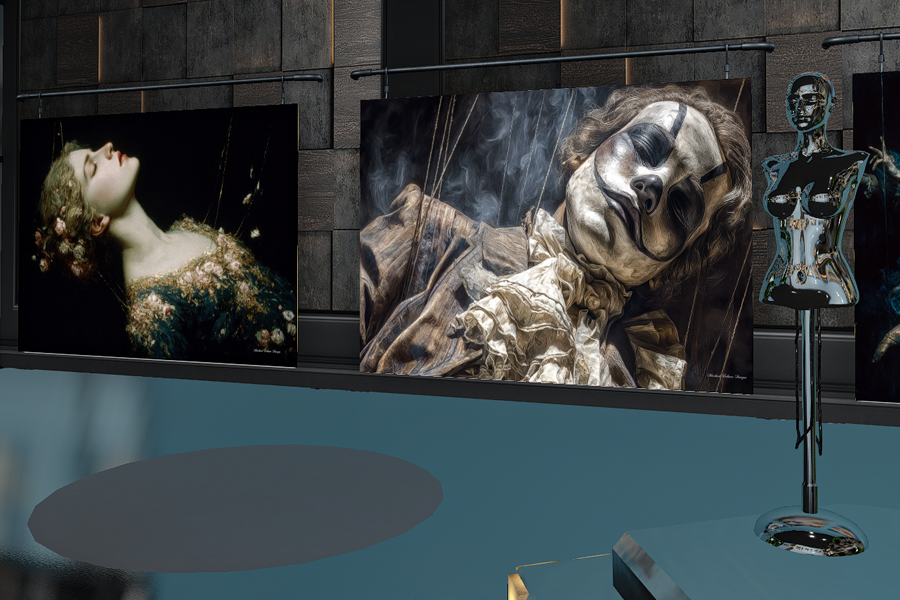
This tension between beauty and restraint becomes especially potent in his marionette and dancer series. Graceful figures hover between motion and suspension, elegance and confinement. Delmar sees these works as layered analogies, operating simultaneously on personal and societal levels. “There are multiples of analogies even in one image,” he explains. “The two evolutions are the individual and the whole.” Submission and resistance coexist in these figures—not as contradictions, but as forces locked in constant negotiation.
Stylistically, Delmar ranges widely. Rococo portraiture sits comfortably beside desert nomads, science-fiction travelers, folkloric winter scenes, and symbolic urban visions. Yet the work never feels scattered. When asked what unifies such varied imagery, Delmar points not to aesthetics but to lived experience. “Wherever a group of people or individuals find themselves born into, they learn to survive and thrive,” he reflects. Across cultures and eras, he sees a shared rhythm—a “heartbeat of life”—that shapes how people adapt, endure, and move forward. If there is a signature to his work, he suggests, it lies in his pursuit of “Truth, Beauty, or Goodness” as guiding criteria rather than a fixed visual style.
In the end, Michael Delmar’s art does not ask to be decoded so much as entered. His figures carry stories we recognize even when we cannot name them. They look at us, turn from us, walk onward, or stand suspended—each one holding space for the unspoken. And like any true journey, the meaning is not handed to us at the threshold. It is discovered, quietly, as we move through.
Michael Delmar’s work can currently be seen at:








Michael’s work speaks volumes… it comes alive and throws itself at you from the canvas. I encourage any/everyone to visit his exhibits, there’s bound to be several pieces you’ll fall in love with!
Michael is an incredible artist. His imagination is limitless and each picture is so detailed that you can feel it come alive. You really need to follow his exhibits to appreciate the true talent of this wonderful man. I promise his art will always give you something to think about with each interpretation of each piece. Wonderful article, Sethos!