
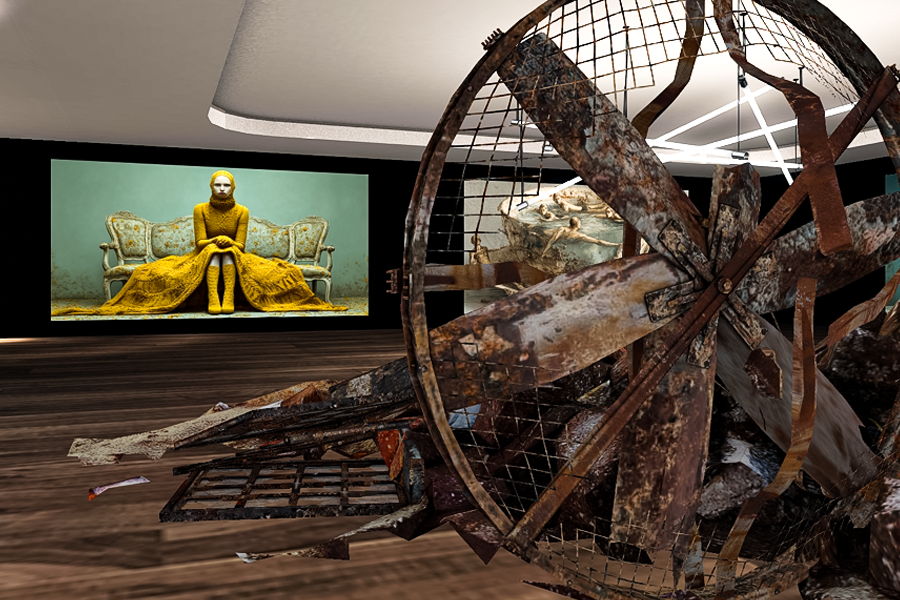
There is a moment, standing in front of Monique Beebe’s work in Second Life, when you realize you are no longer simply looking at images. The images are responding to you.
Even knowing you are present only as an avatar, the experience resists easy dismissal. Figures move as you turn, a face activates behind you, a body crosses your field of vision just as you think you have passed it by. What might otherwise be dismissed as “just art” begins to feel uncannily present—not sentient, but responsive—and that responsiveness lies at the heart of what Beebe is exploring.
“There is a moment, standing in front of Monique Beebe’s work in Second Life, when you realize you are no longer simply looking at images. The images are responding to you.”
At first glance, her work draws on familiar visual languages: fashion photography, glamour, youth, beauty. Yet these languages are never allowed to remain comfortable. They are interrupted and quietly subverted through motion, restraint, intrusion, or reversal. A woman poses and then breaks the pose. A seductive gaze turns out not to be meant for the viewer at all. A body is carefully covered, only to reveal something unexpected. In Beebe’s work, polish is always conditional.
Running through this body of work is a sustained inquiry into visibility—who is seen, under what conditions, and at what cost. Youth is not treated as innocence or reward, but as something acted upon, shaped, packaged, and inherited. When older women appear, they are neither softened nor erased. They remain fully present. Age, here, is not a failure of beauty, but a different register of endurance.
The gaze is everywhere in Beebe’s work, yet it is never stable. Sometimes her figures meet it directly; at other times, they look past the viewer or toward someone else entirely. In some works, eyes are masked or closed. The effect is quietly disorienting. The viewer cannot settle into mastery. Looking becomes an exchange rather than an act of consumption.
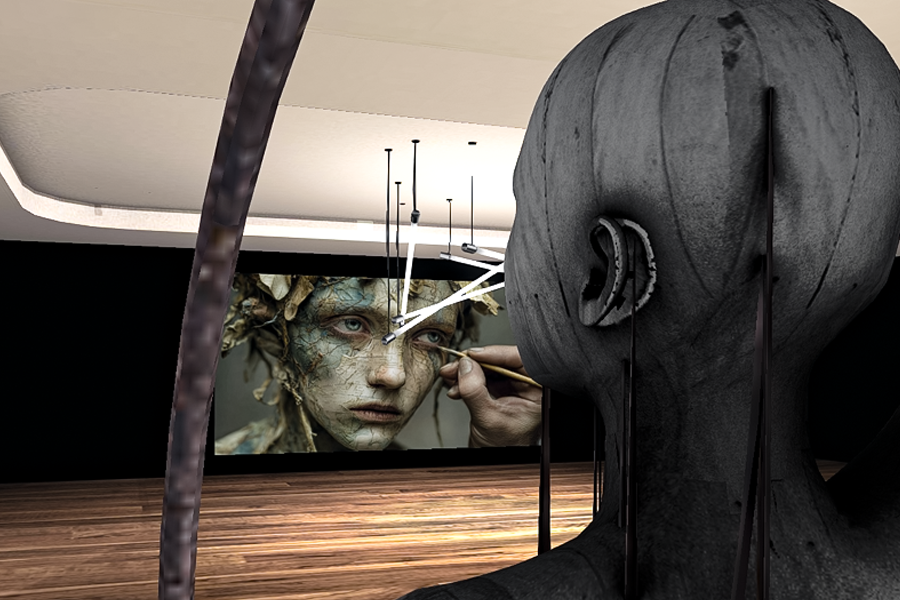
Kondor Art Center: Monique Beebe Exhibit “Dreamworlds”
Motion is central to this destabilization. Animation is never decorative; it reveals structure. Small movements expose choreography, gestures interrupt decorum, and hands enter the frame to paint, mark, or complete a body. In some works, motion feels collaborative—almost joyful. In others, it becomes coercive. The same tools that make a body visible can also make it survivable, or deny it that possibility.
Recurring motifs—coverings, packaging, fruit, water—reinforce this tension. Oranges shift in meaning from abundance to burden, from inheritance to decay. Water may suffocate or sustain. Clothing may protect or function as skin. What appears to be surface is often structure, and what promises revelation ultimately delivers bone.
Second Life itself becomes part of this system. It is not a neutral container, but an active collaborator. Because the images respond to proximity and movement, the viewer’s body—even a virtual one—is implicated. Invisibility is no longer an option. Presence triggers what unfolds.
“In Beebe’s work, polish is always conditional: a pose breaks, a gaze redirects, and what appears to be surface reveals something structural underneath.”
This is where the experience becomes quietly profound. In a physical gallery, art waits patiently; here, it does not. It moves as you turn, appears when you think you are alone, and refuses to remain safely contained as an object. In doing so, it mirrors the questions Beebe’s work asks again and again: what does it mean to be seen, what does it mean to be drawn, and when does visibility become obligation rather than gift?
Monique Beebe’s art does not answer these questions. She stages them—from different angles, through different bodies, under different pressures. Some works feel tender, others unsettling. A few offer moments of resistance or movement without permission. None allow the viewer to remain unchanged.
To encounter her work in Second Life is to experience art that does not simply represent presence, but enacts it. Once you have felt images respond to your turning and your nearness, it becomes difficult to return to the idea of art as something that merely waits to be seen.
Monique Beebe’s artwork can currently be experienced at the Souland Art Gallery and the Kondor Art Center in Second Life.